
Javert’s Crisis of Conscience
Les MisérablesThis thread shows how repeated encounters with Jean Valjean force Javert to confront contradictions in his absolute faith in law.
increasing Bearing strength in each event
 decreasing
Bearing strength in each eventdecreasingAn Officer’s Certainty
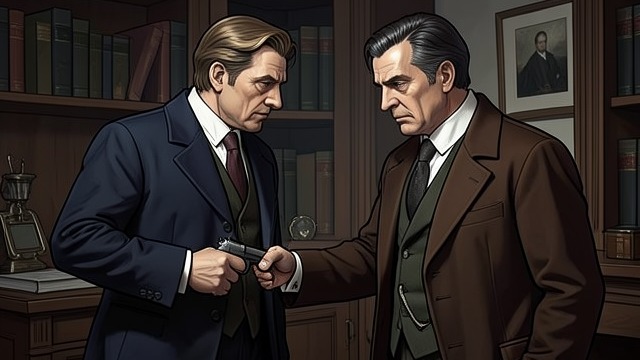
An Officer’s Certainty
A fixed moral division
Inspector Javert sees society through a sharp distinction between lawful people and criminals. Jean Valjean’s respectable life as Monsieur Madeleine cannot reassure him.
The cart rescue supplies what Javert takes to be physical proof of Valjean’s hidden convict identity. His suspicion is rooted in observation, but his judgment leaves little room for change.
The pursuit begins
Javert follows the possibility that Madeleine is a fugitive from the galleys. He treats concealment as evidence of guilt and lawbreaking as a stable character.
His certainty grants him clarity and authority. It also prepares the crisis that follows when Valjean repeatedly acts with unexpected goodness.
An Arrest at the Infirmary
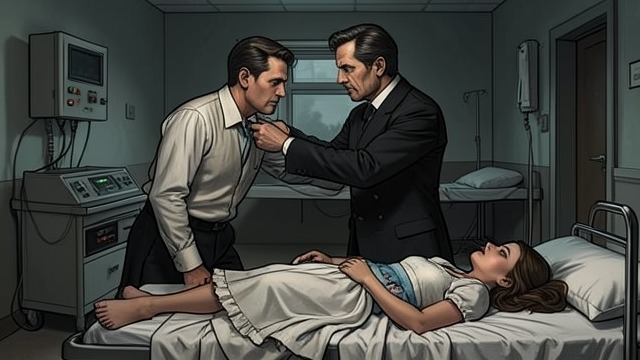
An Arrest at the Infirmary
The suspect identified
Javert arrests Jean Valjean after the trial at Arras confirms his identity. He treats the arrest as the straightforward restoration of legal order.
Valjean asks for three days to fetch Cosette for the dying Fantine. Javert refuses, seeing the request as a likely evasion.
Law without mercy
Fantine dies amid the arrest, her hope of seeing her daughter broken by the revelation. Javert does not intend her death, but his conduct leaves no space for the human need before him.
The episode shows that the officer’s certainty can produce suffering without making him personally cruel in his own eyes.
The Prisoner He Spares
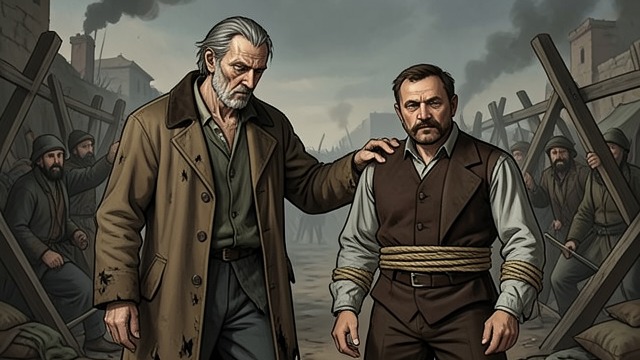
The Prisoner He Spares
Defeated authority
Javert is exposed as a police agent and taken prisoner by the insurgents. He expects execution and asks the rebels to kill him immediately.
Jean Valjean receives custody of him and leads him away from the barricade. Javert expects revenge from the man he has pursued.
The unexpected release
Valjean cuts Javert’s bonds and tells him that he is free. He even gives his address, allowing Javert to find him later.
Javert’s assumptions about the moral character of a convict are contradicted by an act he cannot dismiss. He leaves alive but with his worldview unsettled.
A Second Mercy
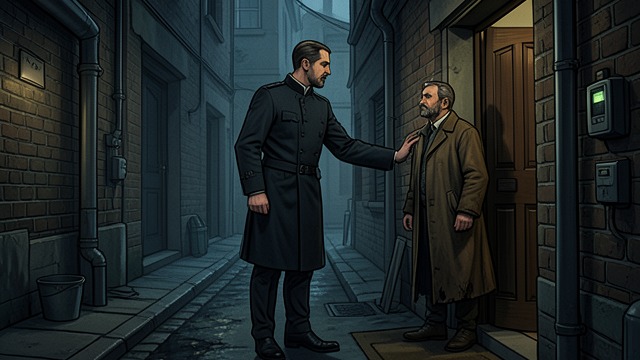
A Second Mercy
The fugitive in reach
Javert captures Jean Valjean again after the sewer rescue. Marius is gravely wounded, and Valjean asks the officer to help take him home before dealing with the arrest.
Javert helps, then allows Valjean to go into the Rue de l’Homme-Armé. The decision cannot be explained by his former distinction between lawful duty and personal feeling.
The officer unmoored
Javert recognizes that he has twice spared the fugitive and once been spared by him. The man he calls a criminal has acted more mercifully than the officer’s own rules allow.
The contradiction is no longer theoretical. Javert’s identity depends on principles that his own actions have begun to disprove.
The River’s Answer
The River’s Answer
A world without a rule
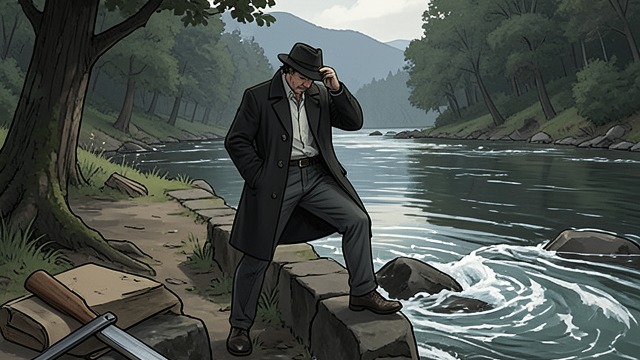
Javert walks through Paris unable to decide whether arresting Jean Valjean would be justice or a betrayal of conscience. To let him remain free seems equally impossible under Javert’s old beliefs.
His identity as an officer has offered him a simple moral structure. Jean Valjean’s mercy has broken that structure without providing Javert a replacement.
Death by the river
Javert writes routine observations for the police before returning to the riverbank. He then removes his hat, climbs over the parapet, and falls into the Seine.
His suicide is not a victory for law or a punishment of Valjean. It is the final consequence of being unable to live with the contradictions that mercy has revealed.
Around 1821, at Montreuil-sur-Mer
1823, at Fantine’s deathbed
June 5, 1832, at the barricade
June 6, 1832, beside the Seine
June 7, 1832, at the Seine
